Temperature-controlled fixtures
Integrate with a cold plate or fixture, defining the heat load, target temperature and required stability.
 Thorthek CM (Thailand) Co., Ltd.
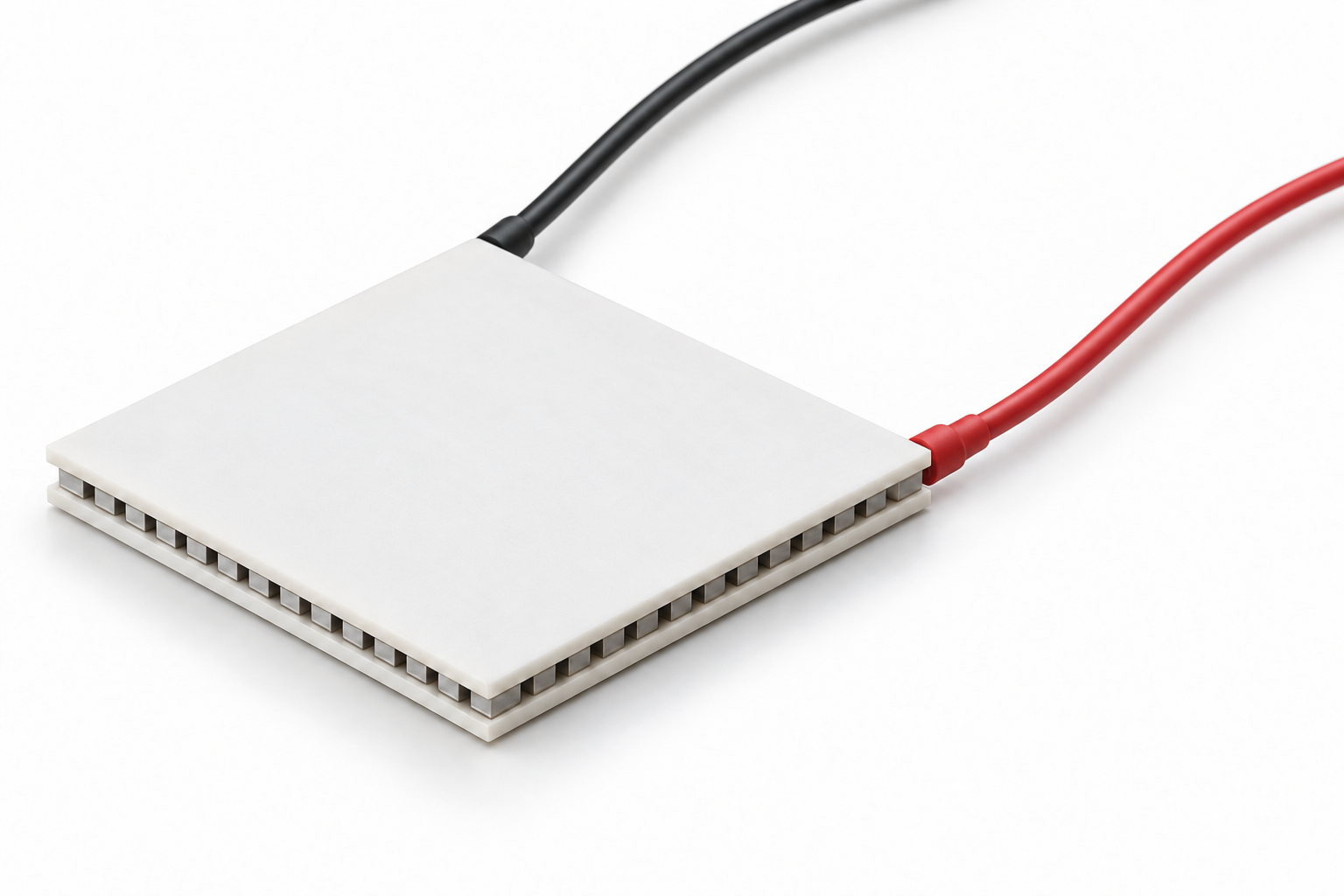
Thermoelectric cooling module for integration into fixtures or temperature-control equipment. Select according to the heat load and hot-side heat rejection system.
Pricing, available quantities, lead time and warranty are confirmed in the quotation.
TEC1-12706SR is a commercial reference code. Technical information in the catalogue references several TEC1-12706 family models. Confirm the manufacturer, grade and delivered lot specifications before ordering.
Driver, temperature sensor, heat sink, fixture and system assembly are quoted separately.
From catalogue Rev. 01 · October 2026
Model-family data, not a combined certified specification for the SR model
| Parameter | HB / Th 25 °C | HB / Th 50 °C | Roßmann / Th 30 °C |
|---|---|---|---|
| Qmax | 50 W | 57 W | At least 51 W |
| ΔTmax | 66 °C | 75 °C | At least 65 °C |
| Imax | 6.4 A | 6.4 A | 6.0 A |
| Vmax | 14.4 V | 16.4 V | 15.4 V DC |
| Length × Width | 40 × 40 mm | 40 × 40 mm | 40 ±0.5 mm per side |
| Thickness | 3.8 mm | 3.8 mm | 3.7 ±0.1 mm |
Catalogue sources: HB TEC1-12706 Rev. 2.03 and Roßmann RO6.0-51.4. These references do not establish equivalence with the SR model.
Qmax and ΔTmax describe different limiting conditions and are not achieved simultaneously. Select the operating point according to the heat load, hot-side temperature and actual temperature difference.
View full reference data and curves in the PDF ↓Integrate with a cold plate or fixture, defining the heat load, target temperature and required stability.
Evaluate applications in confined spaces and provide adequate hot-side heat rejection.
Compare dimensions, thickness, leads, sealing and ratings with the original part. Test samples under the actual operating load.
Temperature control requires a current-limited driver, feedback sensor, thermal interface material and suitable hot-side cooling. The module alone does not determine the system's temperature accuracy.
Check polarity and the hot/cold sides before use. Mount on flat surfaces with uniform clamping force, and assess condensation when cooling below ambient temperature.
Provide the quantity, target temperature and tolerance, heat load, ambient or coolant temperature, installation space and duty cycle. Include the original model for replacement applications.